Electronic Press Kit Checklist: What to Include in Your EPK
Build an electronic press kit that bookers and journalists actually read. Complete EPK checklist covering bios, press photos, tech riders, and music links.
By PlaylistProfit Editorial Team · Updated 2026-11-19
An electronic press kit (EPK) is a centralized, digital resume that gives music journalists, venue bookers, festival talent buyers, and playlist curators everything they need to review, cover, or book your project. When an industry professional asks for your press kit, they expect immediate access to high-resolution media assets, well-structured biographical information, streaming links, and operational details without digging through external accounts or broken download folders.
A disorganized or incomplete EPK slows down decision-makers who evaluate dozens of submissions daily. If a journalist has to email you back for a horizontal photo or a promoter cannot find your input list, they frequently move on to the next pitch. This guide provides a complete checklist for assembling a functional EPK that accommodates the exact workflows of press and booking professionals.
How Bookers and Journalists Actually Use Your EPK
To design an effective press kit, you must understand the constraints of the professionals reviewing it. Music writers, editors, radio hosts, and talent buyers do not browse your kit for entertainment; they are looking for specific assets to complete concrete tasks under strict deadlines.
The Journalist Workflow
Music journalists generally operate under rapid publication schedules. When opening an EPK, their primary questions are: What does this artist sound like? What is their current narrative or news peg? Is there a pull quote or unique angle for my column? Can I quickly grab a high-resolution, print-ready image with the photographer properly credited?
If a writer decides to cover your single, they will not rewrite your life story. They copy relevant sentences from your medium bio, embed your approved streaming track, download an image that matches their site layout, and publish. If assets are missing or locked behind sign-up walls, your coverage is jeopardized.
The Talent Buyer and Booker Workflow
Promoters and talent buyers view your EPK through a logistical and financial lens. They need to answer three foundational questions:
- Draw and track record: Where have you played recently, what venues did you fill, and what audience do you bring to their market?
- Live performance quality: Does your live video prove you can hold an audience's attention and execute your material reliably?
- Logistical feasibility: Does your stage setup fit their stage dimensions and technical production capabilities?
A promoter will scan your live video links first, check your tech rider, glance at your social proof, and check who to contact for confirmation. Knowing these distinct workflows dictates how you should structure your materials.
The Complete EPK Checklist Overview
Before examining each element in detail, review the core components every professional press kit requires:
- Biographies: Short, medium, and long versions formatted for immediate copying.
- Press Photography: High-resolution landscape and portrait orientations with clear photo credits.
- Music Links: Streamable, unreleased preview links and downloadable broadcast-quality audio files.
- Video Content: Clean live performance recordings and official music videos.
- Press Quotes and Milestones: Sourced reviews, playlist placements, and measurable achievements.
- Show History: Notable past venues, festivals, and confirmed upcoming dates.
- Contact Information: Direct points of contact for management, press, and live booking.
- Technical Rider and Stage Plot: Explicit channel requirements, audio routing, and spatial layout for live acts.
You can assemble these assets manually or streamline the presentation using our free EPK builder to create a clean, responsive press hub that loads quickly on both desktop and mobile devices.

Crafting Your Artist Bio: The Three-Tier System
One of the most common mistakes independent artists make is providing a single, four-paragraph biography. An editor compiling a festival preview guide needs 50 words; an interviewer conducting an in-depth feature profile needs 400. Supplying three distinct tiers ensures that media outlets have access to the exact length their layout requires.
Tier 1: The Elevator Pitch (Short Bio, 25 to 50 Words)
This is your capsule summary. It must state your artist name, geographic base, primary genre or sonic identity, and your most significant achievement or current focus. Festival programs, event listings, and social media roundups use this version.
Example Structure: "Hailing from Bristol, [Artist Name] creates cinematic post-punk driven by motorik rhythms and analog synthesizers. Following performances at Green Man Festival and regular airplay on BBC Radio 6 Music, their sophomore EP, [Title], arrives this autumn."
Tier 2: The Working Press Bio (Medium Bio, 100 to 150 Words)
This is the workhorse of your EPK. Online publications, playlist curators, and local venue previews rely heavily on the medium bio. It expands upon your sound, highlights your critical reception, describes your key influences or conceptual themes, and outlines your release history.
Focus on concrete facts rather than hyperbolic self-praise. Avoid empty phrases like "transcending genre boundaries" or "crafting unforgettable sonic journeys." Instead, explain the tangible instrumentation you use, who produced the record, and where you have established regional traction.
Tier 3: The Comprehensive Feature Bio (Long Bio, 300 to 450 Words)
Reserved for feature articles, extended podcast interviews, and formal festival programs, the long bio offers your complete narrative arc. Structure it chronologically across three or four paragraphs:
- The Hook and Current Project: Lead with your current release or tour and establish your core musical identity.
- Origins and Trajectory: Briefly touch on formative projects, key collaborative relationships, and your development as a songwriter or performer.
- Critical Proof: Cite notable reviews, institutional support (such as arts council grants or festival showcases), and chart or streaming milestones.
- The Road Ahead: Detail the narrative thesis of your upcoming project and state where audiences can experience your work next.
Press Photography: Resolutions, Orientations, and Credits
Journalists frequently discard submissions simply because the supplied photography is unusable for web or print layouts. Your visual assets must adhere to industry standards to guarantee publication readiness.
Required Formats and Orientations
Always provide both horizontal (landscape) and vertical (portrait) options. Blog headers, print banners, and magazine double-page spreads demand landscape crops (16:9 or 3:2). Mobile news feeds, Instagram promo carousels, and single-column sidebars require portrait formats (4:5 or 2:3).
- Print Specifications: 300 DPI, minimum 3000 pixels on the longest edge, formatted as uncompressed JPEG or TIFF.
- Digital Specifications: 72 DPI, optimized for fast web loading (under 2MB), formatted as standard sRGB JPEG.
- Visual Diversity: Include at least one clean portrait, one full-body or environmental shot, and one energetic live performance photograph.
File Naming and Legal Clearances
Never leave photo files named "IMG_4901.jpg." Publications will download dozens of images into a single folder; poorly labeled assets will be lost or credited incorrectly. Use a rigid naming convention:
ArtistName_PressPhoto_Location_Credit_PhotographerName.jpg
Ensure you possess written commercial and editorial rights for every image included in your kit. Explicitly list the photographer's name and portfolio handle directly beneath the image download link in your EPK.
Music Delivery: Streamable Links and Broadcast Downloads
Your audio presentation must balance friction-free listening with access to uncompressed master files for radio producers and sound engineers.
Private Streaming Links
If pitching unreleased material, host private tracks via private SoundCloud links or unlisted platform uploads. Ensure that permissions permit streaming without requiring the listener to create an account or install an app. Always enable downloads on private SoundCloud uploads so that radio producers can grab the track immediately if they approve it.
For evaluating your track's commercial suitability and metadata strength before pitching, use a free song analyzer to verify that technical levels align with platform distribution benchmarks.
Broadcast-Quality Master Downloads
Include a clearly labeled folder (hosted on a clean cloud directory like Google Drive or Dropbox) containing your lead singles. This folder must include:
- 24-bit / 44.1kHz WAV files: Clean masters intended for terrestrial or satellite broadcast.
- 320kbps MP3 files: Tagged with complete ID3 metadata (Artist, Title, Album, ISRC, Year, Composer, Contact Info, and embedded Cover Art).
- Radio Edits / Instrumentals: If your lead single contains explicit language or complex vocal sections, provide a clean radio edit and a broadcast-quality instrumental.
Video Assets: Live Demonstrations and Visual Storytelling
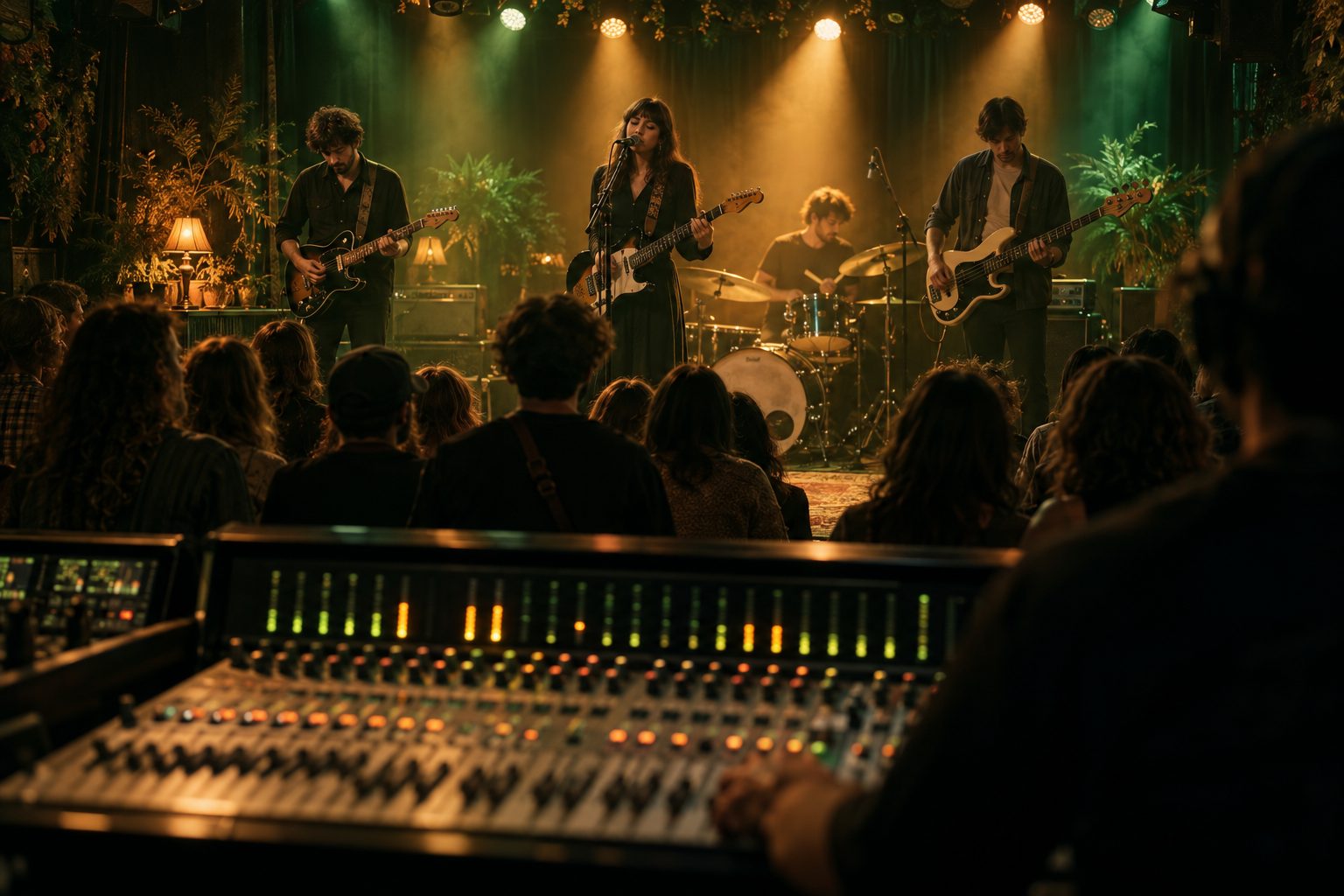
Promoters rely on video assets far more than studio recordings. A studio track demonstrates songwriting ability, but live footage demonstrates whether you can hold a stage, interact with crowds, and deliver professional sound reproduction.
High-Priority: Live Performance Footage
Embed one or two high-definition live recordings. This does not need to be an arena production; a multi-camera session in an authentic rehearsal room or an intimate venue show with clean audio from the soundboard is sufficient. Avoid shaky smartphone clips shot from the back of a loud club with distorted vocal frequencies.
Official Music Videos and Visualizers
Include links to your primary official music videos hosted on YouTube or Vimeo. Videos establish your aesthetic world and provide editors with embeddable media for digital reviews. If you maintain an artist profile or artist landing page, ensure your primary music video is visibly linked alongside your EPK documentation.
Press Clippings, Social Proof, and Show History
Industry decision-makers look for third-party validation to mitigate the risk of booking or covering an unknown artist. Curating your social proof correctly separates an amateur pitch from a seasoned professional presentation.
Curating Press Quotes
Do not paste entire review articles into your press kit. Pull one or two impactful sentences from credible publications, respected regional blogs, or recognized curators. Format each pull quote with the source name bolded:
"[Artist Name] delivers an unrelenting masterclass in rhythm, carving out one of the most cohesive guitar releases of the year." — The Line of Best Fit
If you have not yet received formal press coverage, cite notable playlist inclusions, verified radio rotation, or quotes from established artists who have shared a stage with you.
Organizing Show History
Maintain a concise record of your live accomplishments. Structure your history chronologically under two subheadings:
- Selected Past Dates: Highlight notable venues, support slots for larger touring acts, and festival appearances. Include market details (e.g., "Supporting [Headliner], Electric Ballroom, London — Sold Out").
- Upcoming Schedule: Display confirmed tour dates, residency slots, and showcase invitations so bookers see your active calendar.
Technical Rider and Stage Plot for Live Acts
For bands, duos, and electronic acts that perform live, the technical rider is non-negotiable. It informs the venue's front-of-house (FOH) engineer and production manager exactly what equipment you bring, what equipment the venue must provide, and how your stage must be wired.
The Input List (Patch Sheet)
The input list details every channel sent to the FOH mixer. Lay this out as a clean, sequential table:
- Channel 1: Kick Drum (Mic: Shure Beta 52 or equivalent / Provided by Venue)
- Channel 2: Snare Top (Mic: Shure SM57 / Provided by Venue)
- Channel 3: Bass DI (XLR Output from Bass Amp Head / Artist provides DI)
- Channel 4: Guitar Amp (Mic: Sennheiser e906 / Provided by Venue)
- Channel 5: Lead Vocal (Mic: Shure SM58 / Artist brings mic)
- Channels 6-7: Synthesizer Stereo (Stereo DI box / Artist provides)
The Stage Plot
A stage plot is a top-down visual schematic showing where each performer, instrument, amplifier, power drop, and vocal microphone stands on stage. Include arrows indicating where monitors are required. Clear diagrams prevent delays during changeovers and festival turnarounds.
Hospitality and Accommodation Requirements
If touring regionally or nationally, summarize your basic hospitality needs clearly at the bottom of the rider: required parking accommodations, secure load-in instructions, dietary restrictions, and green room essentials. Keep demands professional and reasonable relative to your career tier.
Step-by-Step: Assembling and Maintaining Your EPK
Executing an electronic press kit requires methodically gathering assets, choosing an accessible hosting structure, and establishing an ongoing update routine.
- Audit your existing media assets: Collect your three bio lengths, identify two strong press photos, verify your audio links, and confirm photographer permissions.
- Build your technical documentation: Create an accurate input list and stage plot using diagramming software or vector templates. Export these as a single, lightweight PDF.
- Choose your hosting medium: Host your EPK on a dedicated, unlisted web page on your domain or via a specialized press kit builder. Avoid sending raw zip files or large email attachments. Decision-makers prefer clean web links containing downloadable master folders.
- Test mobile and desktop accessibility: Review the page on a mobile browser. Ensure that audio players start instantly, PDF downloads open without permission blocks, and image links direct to raw files.
- Update after every milestone: Set a recurring monthly calendar reminder to refresh your EPK with newly acquired press quotes, revised show dates, and updated streaming metrics.
Common EPK Mistakes That Cost You Coverage
Eliminating friction from your press kit requires avoiding predictable logistical errors that irritate industry contacts:
- Attaching heavy files to initial email pitches: Never attach 20MB zip archives of MP3s or TIFF photos directly to an email. This clogs inboxes and frequently triggers corporate spam filters. Always provide an accessible, streamlined link.
- Hiding contact information: If a writer is on deadline and needs a high-res photo or clarification on a lyric, they will not fill out a generic website contact form. Display direct email addresses and phone numbers for your primary contacts clearly.
- Outdated touring schedules: Leaving a tour schedule from eight months ago on your front page signals to bookers that your project is inactive or poorly managed.
- Uncredited media: Failing to name your photographer or videographer creates legal risk for print publications and demonstrates a lack of professional etiquette.
- Broken cloud links: Check that your Google Drive, Dropbox, or streaming links do not display "Access Denied" or "Request Permission." Test your links in an incognito window before sending pitches.
Maintaining a Sustainable Promotion Routine
Your electronic press kit is not a static document; it is a live representation of your creative enterprise. As your audience expands and your critical footprint deepens, your press assets should reflect that momentum. When preparing a major campaign, pair your EPK updates with strategic outreach, leveraging insights from our music promotion guides to pitch curators and editors at the right release windows.
By respecting the time, workflows, and technical parameters of journalists and venue bookers, your EPK becomes an active commercial asset that removes roadblocks, accelerates confirmations, and secures media placement for your music.
More music promotion guides · Free Song Analyzer · Playlist campaigns